
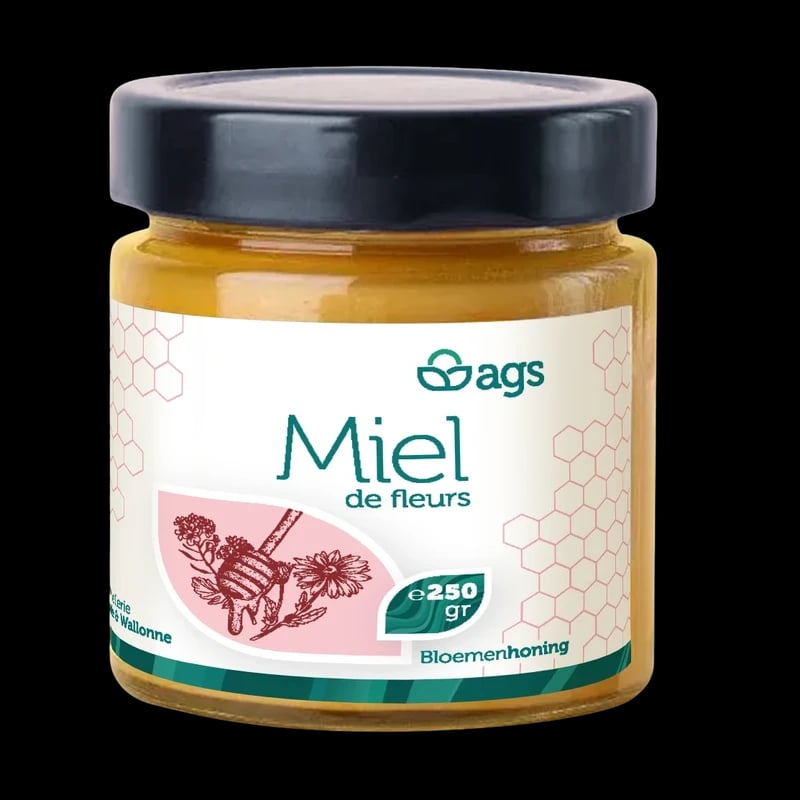
250 g
·
Belgian blossom honey, a table honey in a re-closable 250 g glass jar.
In Stock
1
Belgian blossom honey: the bees forage on the edges of the High Fens.
Jarred in the Verviers area, in Belgium.
Cold extraction, a gentle method that preserves the aromas of the nectar.
A single ingredient: 100% Belgian honey.
A spoonful in a hot drink — tea, herbal tea, coffee —, on a slice of bread, in a yoghurt, with a cheese or in a vinaigrette.
Quantity marker: the nutritional values are given per 100 g, i.e. 321 kcal and 80 g of sugars. A spoonful takes only a small fraction of that — dose according to your taste, as you would with sugar.
Take it out with a clean, dry spoon, and close the jar again after use.
Store away from light and heat. Crystallisation is a natural phenomenon of honey: it alters neither the taste nor the quality of the product.
Nutritional values per 100 g
| Component | Amount | % NRV* |
|---|---|---|
| Energy | 1365 kJ | — |
| Energy | 321 kcal | — |
| Fat | g | — |
| of which saturates | g | — |
| Carbohydrate | 80 g | — |
| of which sugars | 80 g | — |
| Protein | 0.3 g | — |
| Salt | 0.01 g | — |
100% Belgian honey. Origin of the honey: Belgium (Wallonia, Verviers area).
Do not give to children under one year of age: honey may contain spores of Clostridium botulinum, against which the intestinal flora of the infant does not yet defend itself.
People allergic to pollen or to bee products should seek advice before consuming it.
Sweet product, to be consumed as part of a varied and balanced diet. Honey is not a sugar substitute: it has the carbohydrate load of sugar, and people who monitor their blood sugar will take that into account.
Sweet and sticky, it calls for tooth brushing, in particular in the child and in the evening.
None of the allergens subject to mandatory declaration in Annex II of Regulation (EU) No 1169/2011 is present in the composition.
| Pregnancy | Suitable |
| Breastfeeding | Suitable |
| Children | Not recommended |
| On medication | Suitable |
It is a Belgian honey: the bees forage on the edges of the High Fens, and the honey is extracted cold then jarred in the Verviers area, in Wallonia. The jar carries no designation of origin: "on the edges of the High Fens" describes the foraging zone, not an exclusive provenance.
It is a blossom honey, also called nectar honey: the bees produce it from the nectar of multiple flowerings, without any one species dominating. There is only one ingredient in the jar — honey — and its colour as well as its aroma vary from one harvest to the next.
From one year of age. No honey is given to a child under one year of age: it may contain spores of Clostridium botulinum, against which the intestinal flora of the infant is not yet armed. Beyond that, it is consumed like any honey.
Yes. Crystallisation is a natural phenomenon of honey, which depends on its sugar composition and on the temperature at which it is stored. It alters neither the taste nor the quality of the product.
Calculated from 3 reviews
Deze bloemenhoning geeft je thee een prachtig aroma en vooral een gezonde zoetigheid
We use cookies to improve your experience on our site. Please choose your preferences regarding the use of cookies.